The Day My Son Came for My $300,000
My son called at 7:12 on a Thursday morning and told me not to make plans for my own afternoon.
“Morning, Mom,” Caleb said, too cheerful for a man who rarely called before lunch. “Renee and I will be by around four. Since the house sale closed yesterday, we figured we’d help you organize everything.”
I stood at my kitchen counter in my robe, both hands wrapped around my coffee mug.
Outside the window, the marigolds along the porch were bright orange in the early sun. Harold had planted that first row almost thirty years earlier because he said marigolds were stubborn little things. “They know how to survive,” he used to tell me.
The house behind me was quiet now.
Too quiet.
Three weeks earlier, I had sold it to a young couple expecting their first baby. They had walked through the rooms with the same nervous excitement Harold and I had carried when we bought the place in 1986. The wife had touched the pantry door and laughed when she noticed the faded pencil marks where we had measured Caleb from first grade through high school.
I smiled for them because I meant it.
Then I went into the bathroom and cried into a hand towel.
The sale left me with just over $300,000 after expenses. Add Harold’s life insurance, my retirement savings, and a modest investment account he had built slowly over forty years, and suddenly I had more money under my name than I had ever managed alone.
That was what Caleb meant by organize.
He meant the money.
“We’ll be there at four,” he repeated. “Don’t make any plans.”
Then he hung up before I could answer.
My name is Margaret Parker. I was seventy-one years old that morning, widowed for two years, and for the first time in my life I had begun to understand that love and trust were not always the same thing.
Caleb was my only child. Harold and I had not been perfect parents, but we had loved that boy with the kind of steady devotion that wears grooves into a life. We packed lunches, sat through freezing baseball games, paid for braces, helped with college, and gave him the down payment for his first small house after he married Renee.
When Harold was dying, Caleb came to the hospital whenever he could. Renee came too, carrying casseroles, binders, and the clean confidence of a woman who liked rooms better when she controlled them.
“You shouldn’t have to handle all these accounts by yourself,” she told me one evening in the hospital cafeteria, sliding a notebook toward me. “Let us simplify things.”
I was exhausted. Harold had been sleeping more than speaking. The bills were stacked on my kitchen table. I had not washed my hair in four days.
So when Renee suggested giving Caleb access to a joint household account so he could pay utilities and insurance while I stayed at Harold’s bedside, it sounded reasonable.
Temporary, she said.
Only to help, she said.
After the funeral, I meant to remove them. But grief makes time strange. Weeks became months. Months became two years.
At first, the missing amounts were small enough to explain away.
Two hundred dollars.
Three hundred.
A charge at a store I did not remember visiting.
A withdrawal I was told must have been for school supplies for Lily, my granddaughter.
Whenever I asked, Renee had an answer before Caleb could speak. Insurance adjustment. Emergency car repair. Medical bill. Forgotten reimbursement.
The explanations were just reasonable enough to make me doubt myself.
Maybe I had forgotten.
Maybe I had misunderstood the statement.
Maybe old age had started quietly, not with a fall or a diagnosis, but with numbers no longer adding up.
Deep down, I knew better.
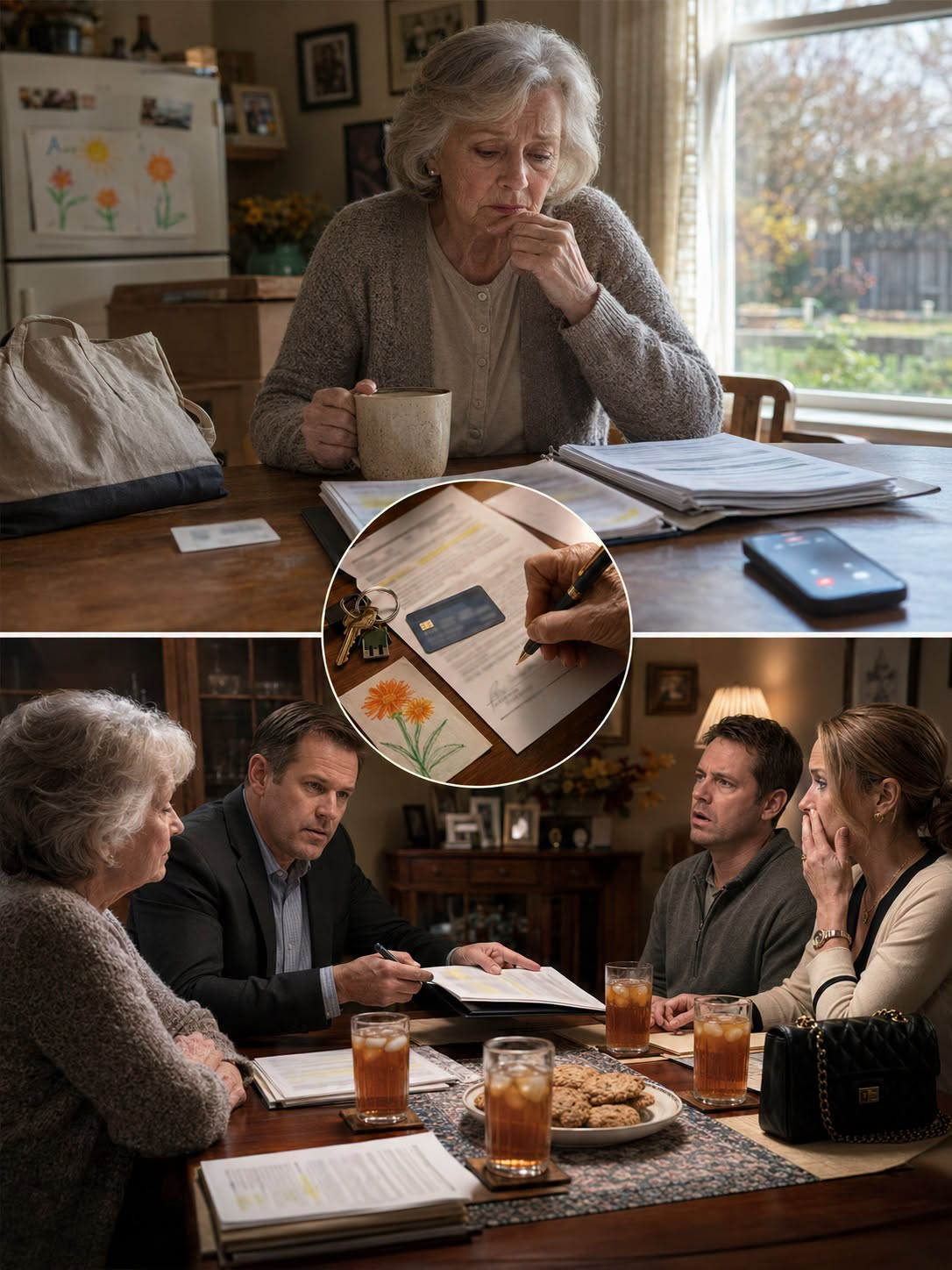
That morning, while Caleb’s phone call still hummed in my ear, a thick folder sat on my kitchen table beside a glass pitcher of iced tea. Inside were six months of bank statements I had printed at the public library because I did not want Renee seeing the activity on my home printer. Every unfamiliar transaction was highlighted in yellow.
Sixteen withdrawals.
Most small.
One was not.
Eight hundred ninety dollars from an ATM in Ashton Falls, nearly sixty miles away.
I had never been to Ashton Falls.
Beside the folder lay a business card: Grace Holloway, Adult Financial Protection Services.
I had called her after sitting in my car outside the library for twenty minutes, ashamed to press the final digit. When she answered, I nearly hung up.
Instead, I told a stranger what I had not been able to tell anyone else.
That I was afraid my son and daughter-in-law were taking my money.
Grace did not gasp. She did not make me feel foolish. She listened so patiently that I cried halfway through the first call out of plain relief.
“Mrs. Parker,” she said when I finished, “this happens more often than people want to believe.”
“I keep thinking I must be imagining it.”
“No,” she said gently. “People who exploit trust usually start small. Small enough that the victim questions herself instead of questioning them.”
Victim.
I hated the word.
I also needed it.
The day before Caleb called, I had met with Martin Doyle, the branch manager at Summit Community Bank. I carried the statements in an old canvas grocery bag because I felt ridiculous walking into a bank with evidence against my own family.
Martin led me into his office and closed the door.
“What can I do for you, Mrs. Parker?”
I put the folder on his desk.
“I need someone to tell me if I’m seeing things.”
He read in silence for almost twenty minutes. Occasionally, he circled something with his pen. Once, his jaw tightened.
When he finally looked up, his voice was careful.
“Did you authorize these withdrawals?”
“No.”
“Did you give your son or daughter-in-law financial power of attorney?”
“I signed medical paperwork while my husband was in the hospital. Not financial.”
He nodded. “Then you were right to come in.”
Those seven words steadied me more than he could have known.
By the time I left the bank, the joint account had been frozen pending review. My pension deposits were redirected into a new account in my name only. My online banking password, security questions, and debit card were changed. Martin also flagged the account history for documentation.
When he slid the final paperwork across the desk, he said, “Your money is secure now.”
I looked down at my signature.
For two years, my life had felt like a room where other people kept moving furniture in the dark. Signing those papers felt like turning on a lamp.
Now Caleb and Renee were coming at four.
I called Grace.
“It’s done,” I said. “The accounts are protected.”
“Good,” she replied. “Now prepare for the part where they notice.”
They noticed before noon.
Renee texted first.
Did something happen with the account?
Then, The debit card isn’t working.
Then, Call us immediately.
Caleb called five times. Renee called seven. I placed the phone facedown beside the pitcher of iced tea and went outside to water Harold’s marigolds.
At exactly 4:13 p.m., a black SUV pulled into my driveway.
Caleb stepped out first, smoothing the front of his jacket. Renee followed in cream slacks, heels too high for my gravel path, and a smile that had always looked most natural when she believed she was about to win.
Before they reached the porch, I opened the door.
“Come in,” I said.
Renee walked past me without waiting.
“We’ve been calling all day,” she said. “Your phone must be broken.”
“It works fine.”
Her smile thinned.
Caleb looked around the living room. Half the family photos had been packed. The brass clock Harold loved was wrapped in newspaper on the side table. A stack of labeled boxes sat near the hallway, waiting for the movers who would take me to my new condominium the following week.
“Mom,” Caleb said carefully, “is everything okay?”
“It will be.”
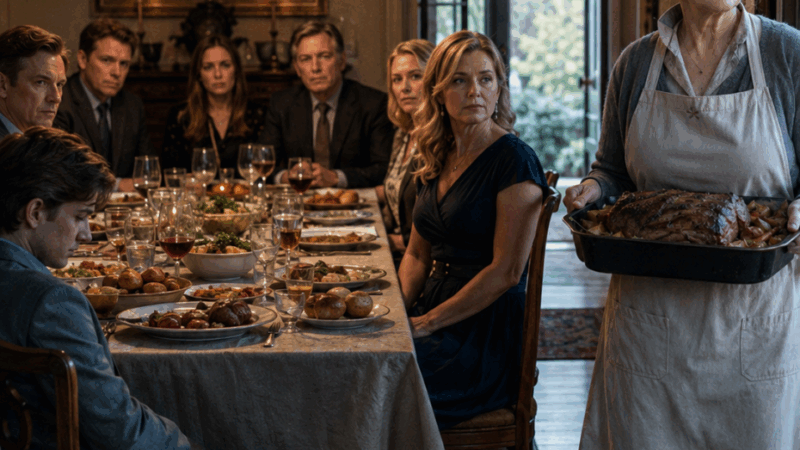
They followed me into the dining room.
Both of them stopped.
A man was already seated at the table, a notebook open in front of him. He stood politely.
“Good afternoon,” he said. “I’m Detective Owen Brooks with the county financial crimes division.”
Renee’s face went pale.
Caleb stared at me.
“What is this?” he asked.
I rested one hand on the back of Harold’s old dining chair.
“This,” I said, “is me finally asking the right people for help.”
PART 2
Renee gave a short laugh that fooled no one.
“There has to be a misunderstanding.”
“That’s what we’re here to determine,” Detective Brooks said.
He gestured to the empty chairs. Caleb sat slowly. Renee remained standing for another moment, as if refusing the chair might keep the room under her control. Then she sat too, crossing her arms.
The detective opened the folder and slid the first highlighted statement across the table.
“Mrs. Parker reports several withdrawals she did not authorize. Let’s start with January 12. Two hundred seventy-five dollars.”
Renee barely glanced at it. “I’d have to check.”
“February 2. Three hundred forty dollars.”
“I don’t remember every little thing.”
“March 18,” he said. “Eight hundred ninety dollars. ATM withdrawal in Ashton Falls.”
The room went still.
Caleb turned toward his wife. “You said that was from your savings.”
Renee’s mouth tightened. “It basically was.”
Detective Brooks did not raise his voice. “Did Mrs. Parker authorize that withdrawal?”
Renee looked at me then, angry and frightened at once.
“You knew we needed help.”
“I knew nothing about it,” I said.
“We’re family.”
“That wasn’t the question,” Detective Brooks said. “Did she authorize it?”
Renee looked down.
“No.”
He wrote one word in his notebook.
Caleb’s face changed while the detective continued through the transactions. Furniture. Restaurant bills. A hotel deposit. Clothing purchases. Cash withdrawals on days I had not left the house.
Each explanation became thinner.
Renee said she meant to pay it back. She said things had been tight. She said I had always helped before. She said Harold would have wanted me to help.
That was when I finally spoke.
“Do not use my husband’s name to justify stealing from me.”
Caleb closed his eyes.
The detective gathered the statements back into the folder.
“This has been referred for formal investigation,” he said. “You may be asked to provide additional records and participate in interviews.”
Renee stood so fast her chair scraped the floor.
“This is ridiculous.”
“No,” I said. “It should have happened sooner.”
She looked at me as if I had become someone new.
Maybe I had.
Caleb stood slowly. “Mom, I honestly didn’t know.”
I searched his face. Maybe he had not known every detail. Maybe he had chosen not to ask because not knowing was easier.
Sometimes those things are only a few inches apart.
“I hope that’s true,” I said. “But hope is not trust.”
His eyes filled.
“I’m sorry.”
“Then prove it over time.”
When they left, I locked both locks.
For the first time since Harold died, the sound did not make me feel lonely.
It made me feel safe.
PART 3
After Caleb and Renee drove away, I carried the untouched oatmeal cookies to the kitchen and wrapped them in foil.
It was a silly thing to do. No one wanted cookies after a financial crimes detective had sat at the dining table. But ordinary tasks can hold a person together when the extraordinary parts of life become too sharp.
Detective Brooks stayed long enough to finish his notes.
“You handled yourself well,” he said.
“I don’t feel like I did.”
“You don’t have to feel strong to make a strong decision.”
I smiled faintly. “I wish I had made it sooner.”
He closed his notebook. “You trusted people you loved. That isn’t the same thing as being foolish.”
After he left, I sat near the living room window and watched evening settle over the yard. The marigolds glowed along the porch, bright and stubborn, their petals catching the last of the sun. Harold would have noticed that. He noticed small faithful things.
I wanted him there so badly in that moment that grief rose up fresh and hot, as if the funeral had been yesterday.
Then I imagined what he would have said if he had seen those bank statements.
Not loudly. Harold had never been loud.
He would have put one hand over mine and said, “Maggie, we are going to handle this.”
So I did.
The next Monday, Grace Holloway recommended an attorney named Daniel Mercer. His office sat above a bakery downtown, and the stairwell smelled like coffee and cinnamon. I remember that because I had expected a lawyer’s office to feel cold. Instead, the building felt ordinary, which helped.
Daniel was soft-spoken, gray-haired, and direct without being unkind.
He reviewed the joint account records, the frozen funds, the proceeds from my home sale, Harold’s insurance policy, my retirement accounts, and the investment portfolio we had spent decades building slowly and carefully.
Then he asked a question that should have been simple.
“Who do you want these assets to benefit?”
For most of my life, the answer would have been automatic.
Caleb.
My son.
My only child.
But the word caught somewhere in my chest.
“I want my wishes respected,” I said at last.
Daniel nodded. “Then we write them clearly enough that no one has to guess and no one can take advantage of uncertainty.”
Over the next two hours, we changed everything that needed changing. I updated my will. I created a revocable living trust. I removed informal access points. I revised beneficiary designations. I named a professional fiduciary as backup financial agent instead of assuming family was always safer than strangers.
Daniel did not make a speech about punishment.
“These documents don’t harm anyone,” he said as he placed them in a blue folder. “They protect you.”
Protection.
Not revenge.
There was a difference, and I was finally old enough to respect it.
A week passed before Caleb texted.
Can we talk?
I read it while rain tapped against the kitchen window. Then I set the phone down.
An hour later, another message came.
I didn’t know everything. But I should have asked more.
That was closer to truth.
Still, I did not answer that night.
Some apologies are only the first knock on a door. They are not a key.
The investigation moved slowly, as investigations do. Detective Brooks called twice for clarification. Martin from the bank confirmed that all unauthorized activity had been documented and that my new accounts were secure. Grace checked in every few days, never prying, always steady.
Renee did not call me directly. That was wise. Through Caleb, I learned she had hired an attorney. The county did not drag anyone away in handcuffs. There was no dramatic scene in a courthouse hallway. Real consequences came in quieter forms: interviews, repayment discussions, legal bills, damaged trust, and the permanent loss of easy access.
I moved into my new condominium the following Thursday.
It was smaller than the house Harold and I had shared, but the windows faced east, and the kitchen had room for my round oak table. I brought the brass clock, the pantry door with Caleb’s height marks cut carefully from the frame, Harold’s favorite armchair, and two large pots of marigolds from the porch.
The young couple who bought the house sent me a photo a month later. They had planted new flowers around the mailbox. In the corner of the image, I could see the fireplace Harold had built slightly crooked because he refused to admit the mantel was uneven.
I cried over that picture.
Not because I regretted selling.
Because grief and relief can live in the same body without asking permission.
My granddaughter Lily became the gentlest part of that season.
She was ten, all elbows and curiosity, with Harold’s serious eyes when she concentrated. Caleb brought her by one Saturday morning after asking three times if it was okay. That was new. Before, everyone assumed my availability.
Lily came in carrying a sketchbook almost as large as her torso.
“Grandma,” she said, “I drew your new place, but prettier.”
“That sounds fair.”
She opened to a page showing a small white cottage surrounded by bright orange flowers. On the porch stood a woman with silver hair and a man in a brown hat.
“That’s Grandpa,” she said. “I know he’s in heaven, but I put him there because Mom says people stay where they’re loved.”
I touched the page carefully.
“It’s beautiful.”
“I remembered the flowers,” she said. “The orange ones.”
“Marigolds.”
“Do they come back?”
“Sometimes,” I said. “If you take care of them.”
She taped the drawing to my refrigerator. Later, we watered the potted marigolds on my balcony and talked about her school art show, her spelling test, and a classmate who kept borrowing erasers without returning them.
It was an ordinary morning.
I had missed ordinary mornings.
Caleb asked again to talk after he dropped Lily off the following weekend. This time, I let him in.
We sat at the oak table with coffee between us. He looked thinner, tired in a way that had nothing to do with sleep.
“I left Renee,” he said.
I kept my hands around my mug.
“That must have been difficult.”
He nodded. “Not as difficult as admitting I let this happen.”
I did not comfort him. That restraint took effort.
He placed an envelope on the table.
Inside was a cashier’s check.
“I sold the motorcycle,” he said. “It isn’t everything. It’s a start.”
I looked at the check but did not touch it.
“You don’t owe me money because you’re my son.”
His voice broke. “I owe you because I failed you.”
Those words went deeper than “I’m sorry.”
He told me he had believed Renee when she said the withdrawals were temporary, or reimbursed, or something I had approved. He admitted he had not wanted to look too closely because looking would have required conflict. He admitted he liked thinking I was fine because it made his life easier.
“I chose peace in my own house over honesty with you,” he said. “That was cowardly.”
I sat very still.
There are moments when a parent wants to rush across the room and erase a child’s shame, even when that child is grown and the shame is deserved. But if I took his guilt away too quickly, I would be teaching him the same lesson that had brought us here: that my comfort mattered less than everyone else’s relief.
So I said, “Yes. It was.”
He nodded and cried quietly.
I reached across the table and placed my hand over his.
“I love you,” I said. “But I cannot pretend this did not happen.”
“I know.”
“Trust will be rebuilt through behavior, not words.”
“I know that too.”
“Then begin there.”
He did.
Not perfectly. Not dramatically. But consistently.
He cooperated with Detective Brooks. He provided records. He entered repayment mediation separate from Renee. He stopped asking me what I was going to do with my money. He called before visiting. He listened when I said no. Sometimes he looked ashamed, and I let him carry that feeling instead of rushing to tidy it away.
By autumn, the marigolds on my balcony had thickened into bright clusters. Every morning, I watered them before the day warmed. I found a rhythm in the smaller life I had once feared.
Coffee at seven.
A walk at eight.
Library on Wednesdays.
Lily after school on Fridays.
I joined a card group in the community room and discovered I was very bad at euchre but surprisingly good at laughing at myself. I bought a new blue coat without asking anyone whether it was practical. I met Grace for lunch once, and when she asked how I was, I answered honestly.
“Peaceful most days. Sad sometimes.”
“That sounds healthy,” she said.
She was right.
Healing did not mean I stopped missing the house. It did not mean I stopped grieving Harold. It did not mean Caleb’s betrayal no longer lived somewhere in me.
It meant those things no longer got to make my decisions.
One cool October afternoon, Lily arrived with another drawing. This one showed my condominium balcony bursting with marigolds. A woman with silver hair sat in a chair holding a mug. Above her, in careful pencil letters, Lily had written, Home is where peace lives.
I taped it beside the first drawing on the refrigerator.
That evening, after she left, I carried my tea to the balcony. The marigolds swayed in the breeze, sturdy and bright. Below, cars passed quietly along the street. Somewhere in the building, a dog barked once and then settled.
My phone rang.
Caleb.
I answered because he had earned that much.
“Hi, Mom,” he said. “Is this a good time?”
I looked at the flowers. Harold’s stubborn little survivors.
“Yes,” I said. “It is.”
Not every wound disappears. Some become part of the map. You learn where the tender places are, and you stop letting careless people step on them.
For most of my life, I thought strength meant giving everything I had to the people I loved.
I know better now.
Real love does not require surrendering your dignity. Real family does not treat trust like an unlocked account. And real peace begins the moment you understand that kindness is not permission.
They did not lose access to me because I stopped loving them.
They lost access because I finally stopped confusing love with being easy to take from.
The end