A Biker Slapped a Teen in a Crowded Supermarket — Then the Security Footage Revealed What Happened First
PART 2
“We’ve got the footage,” the officer said.
And the entire store held its breath.
The small monitor sat on the customer-service counter, surrounded by two officers, the store manager, and an Asset Protection employee wearing a gray polo shirt.
Everyone else crowded behind the yellow line near the registers.
Phones remained raised.
People were still recording.
But now no one was talking.
The officer pressed play.
The screen showed aisle seven from above.
No sound.
Just a wide, grainy view of customers moving between shelves.
At first, nothing looked unusual.
My mother pushed her cart slowly toward the end of the aisle.
The teenager appeared several yards behind her.
Hands inside his hoodie pocket.
Head lowered.
He passed her once.
Then stopped near a display of discounted cereal.
The officer paused the video.
“Watch him,” he said.
He rewound ten seconds.
The teenager’s face lost its color.
On the screen, he looked over his shoulder.
Not at the products.
Not at another customer.
At my mother’s purse.
The bag was hanging from the handle of her shopping cart.
The officer played the footage again.
The boy moved closer.
He reached toward the purse.
My mother noticed him and grabbed the strap.
The teenager pulled.
She held on.
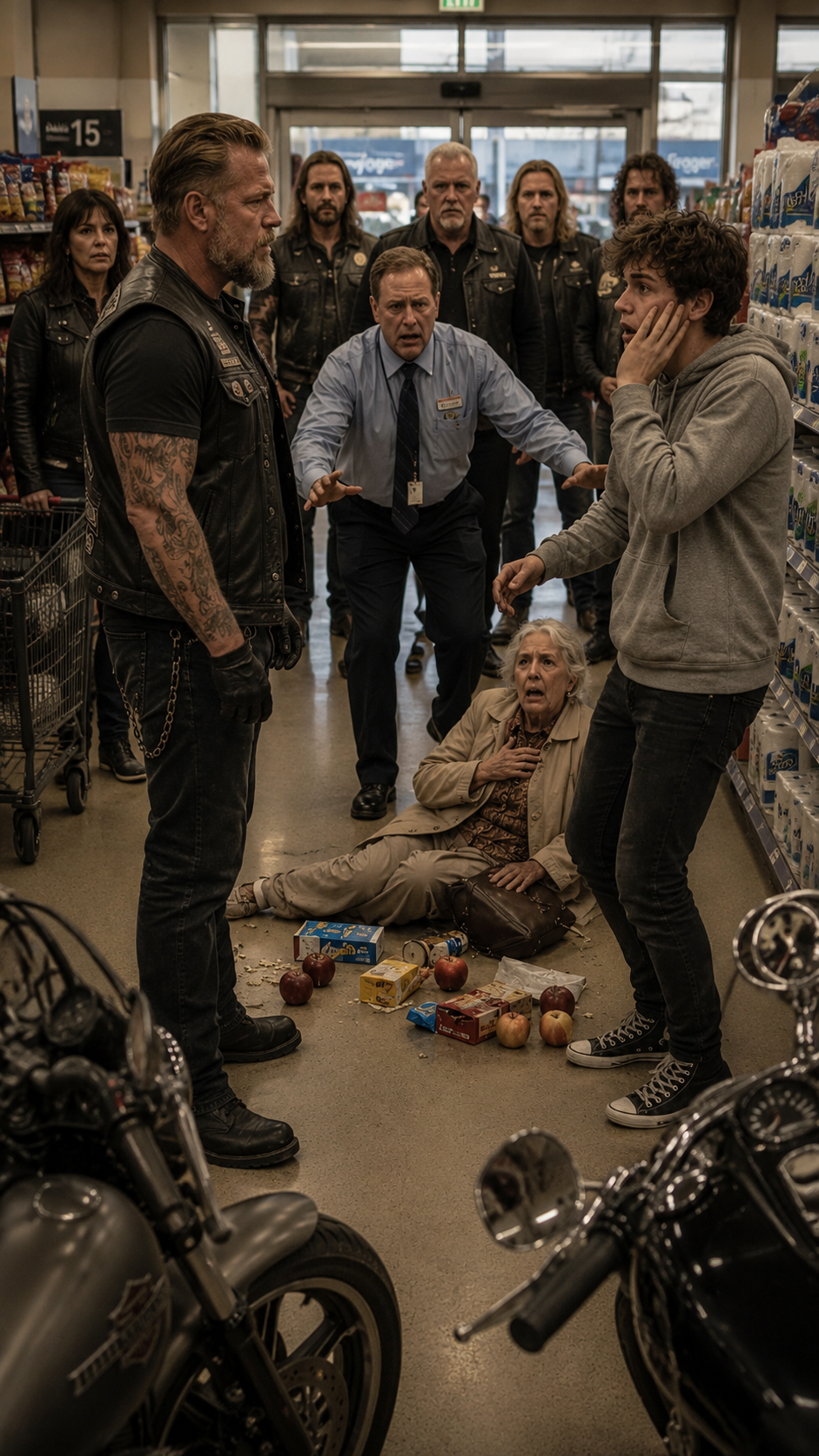
Then he shoved her.
Hard.
Her body struck the floor.
Even without sound, I heard it again in my head.
That terrible impact.
The moment that brought twelve years of anger, guilt, and distance crashing back into my life.
On the screen, the boy tried to run with the purse.
Then I entered the frame.
I grabbed the bag with one hand.
Turned him around.
And slapped him.
The video stopped.
No one in the store spoke.
Thirty phones were still pointed toward us, but the confidence behind them had disappeared.
The woman who had first shouted that I attacked a child lowered her phone to her chest.
The man near the checkout stared at the floor.
The manager slowly turned toward the teenager.
“You said you tripped.”
The boy said nothing.
One officer replayed the shove.
Then replayed it again.
The teenager looked toward the doors.
Marcus and the other riders were standing there.
They did not block him.
They did not move.
They did not need to.
The officer stepped between the teenager and the exit.
“Turn around.”
The boy’s voice rose immediately.
“No, wait. She grabbed me first.”
The officer’s expression did not change.
“Turn around and put your hands behind your back.”
“I’m sixteen!”
“That doesn’t give you permission to rob someone.”
“I wasn’t robbing her!”
The officer pointed toward the monitor.
“We all just watched you do it.”
The boy looked around desperately.
Only minutes earlier, the entire crowd had been defending him.
Now no one met his eyes.
The officer guided his hands behind his back.
When the handcuffs closed, the teenager began to cry.
Not loudly.
Not dramatically.
Just frightened, shallow breaths from a boy who finally understood that the version of the story he had tried to create had collapsed.
A woman near the pharmacy whispered, “Oh my God.”
Someone else said, “We blamed the wrong man.”
But I did not feel victorious.
I did not feel relieved.
Because while everyone else watched the teenager being led away, I was watching my mother.
She was sitting beneath the pharmacy sign with an ice pack pressed against her shoulder.
Her coat was torn near one pocket.
A small line of blood marked the side of her hand.
She looked smaller than I remembered.
Older.
Tired in a way that twelve years of memory had never prepared me for.
The officer turned toward me.
“You were right about the cameras.”
I nodded.
“But you still assaulted a minor.”
“I know.”
The crowd reacted softly.
They had expected me to defend myself.
To say the boy deserved it.
To say anyone would have done the same.
Maybe part of me believed that.
But I knew the officer was right.
The video proved why I had been angry.
It did not make the slap legal.
He asked, “Are you willing to give a full statement?”
“Yes.”
“You may still be cited.”
“I understand.”
The teenager was escorted toward the entrance.
As he passed me, he looked up.
The anger was gone.
So was the performance.
For one second, he looked like what he really was.
A scared sixteen-year-old who had made a terrible decision.
He whispered, “I’m sorry.”
I did not know whether he was speaking to me or my mother.
Maybe he did not know either.
I looked at him and said, “You should tell her.”
The officer stopped.
The boy turned toward the pharmacy counter.
My mother looked back at him.
His chin trembled.
“I’m sorry I pushed you.”
She remained quiet for several seconds.
Then she asked, “Why did you do it?”
The teenager swallowed.
“I needed money.”
“For what?”
He looked down.
No answer.
The officer began guiding him toward the doors again.
My mother called after him.
“You could have killed me.”
The boy stopped.
His shoulders tightened.
“I know.”
“No,” she said softly. “You know now.”
The automatic doors opened.
The teenager disappeared into the parking lot between two officers.
The people filming slowly lowered their phones.
The dramatic part was over.
They had their twist.
They had their proof.
They had the moment when the apparent villain became the man who had stopped a robbery.
But the part nobody recorded came afterward.
And it was worse than the slap.
Because once the crowd began to scatter, there was nothing left between my mother and me except twelve years of silence.
The paramedics arrived and examined her shoulder.
Nothing appeared broken, but they wanted to take her to the hospital for X-rays.
She refused at first.
“I’m fine.”
The paramedic shook his head.
“You hit the floor hard.”
“I’ve fallen before.”
“That doesn’t make this one safe.”
She looked toward me.
It was the first time she had looked directly at me since recognizing my face.
Her eyes moved over my gray beard.
The tattoos.
The vest she had once said made me look like someone she no longer knew.
Then she spoke my name.
“David.”
One word.
That was all it took.
The supermarket disappeared.
The officers.
The phones.
The fluorescent lights.
For a moment, I was thirty-nine years old again, standing in her kitchen while she cried and I pretended not to care.
I had replayed our last argument hundreds of times.
Sometimes I remembered her telling me I was wasting my life.
Sometimes I remembered myself shouting that she cared more about appearances than about her own son.
But memory is dishonest when pride controls it.
For twelve years, I had remembered only the things she said that hurt me.
I had tried not to remember the things I said back.
My mother looked at Marcus and the riders near the entrance.
“They came because you called them?”
“Yes.”
She gave a small, painful nod.
“You always did need an audience.”
The words struck exactly where they were meant to.
Marcus glanced at me.
He expected anger.
So did I.
But I was too tired.
“I didn’t call them for a fight.”
“Why, then?”
“So I wouldn’t stand alone.”
Her expression shifted.
Only slightly.
The paramedic adjusted the ice pack against her shoulder.
My mother winced.
I stepped forward instinctively.
She pulled away.
Not dramatically.
Only an inch.
But that inch contained twelve years.
I stopped.
The officer asked whether she wanted to press charges against the teenager.
She said yes.
Then he asked whether she had seen me strike him.
My mother’s eyes stayed on mine.
“Yes.”
“Do you understand your son may face a separate charge?”
She looked surprised.
The officer continued.
“The footage explains his reaction, but it doesn’t automatically excuse it.”
My mother turned away.
For a moment, I thought she might say I deserved whatever happened.
Instead, she asked, “Is he going to jail?”
“Probably not tonight. We’ll complete the report and speak with the prosecutor.”
She nodded slowly.
Then she said something I did not expect.
“He was protecting me.”
The officer looked at her.
“That will be included in the report.”
“He saw someone hurt me, and he reacted.”
“I understand.”
My mother’s voice tightened.
“You don’t understand. He has always reacted before thinking.”
There it was.
The old accusation.
The old wound.
I almost answered the way I had twelve years earlier.
Almost.
Then she finished.
“But he has also always been the first person to step in when someone was in trouble.”
I looked at her.
She did not look back.
The officer closed his notebook.
“We’ll contact both of you.”
When he walked away, my mother stared at the scattered apples still lying near the dairy case.
An employee had gathered most of her groceries, but one red apple had rolled beneath a shelf.
I bent down and picked it up.
There was a bruise along one side.
I placed it gently into her cart.
She watched me.
“You shouldn’t have hit him,” she said.
“I know.”
“He could have had a weapon.”
“I know.”
“You could have been arrested.”
“I know.”
She shook her head.
“You say that now.”
I looked at the floor.
“I’ve had twelve years to practice being wrong.”
That finally made her face change.
The anger weakened.
Not gone.
Just tired.
Marcus approached slowly.
“David, we’ll wait outside.”
“You don’t have to.”
“I know.”
That was what family sounded like among men who rarely used the word.
They did not stay because they were asked.
They stayed because leaving had never occurred to them.
My mother watched Marcus walk away.
“Is that the man who came to your father’s funeral?”
I looked at her.
“You remember him?”
“I remember all of them.”
“You barely spoke to anyone that day.”
“That doesn’t mean I didn’t see them.”
My father had died fourteen years earlier.
His funeral had been one of the final times my mother and I stood together without arguing.
Several riders from my club attended.
They arrived quietly, stood at the back, and left before the family gathered for food.
My mother had treated them politely.
Afterward, she told me they did not belong there.
At least, that was what I had believed she meant.
Now she looked toward the parking lot where Marcus and the others stood beside their bikes.
“Your father liked them,” she said.
I almost laughed.
“Dad complained about the motorcycles every time they came over.”
“He complained about everything.”
That was true.
My mother looked down at her trembling hands.
“He said those men would be the ones who showed up when everyone respectable found an excuse not to.”
I stared at her.
“You never told me that.”
“You never asked.”
The answer hurt because it was true.
The paramedic returned with a wheelchair.
My mother refused it.
Then tried to stand.
Her knees gave slightly.
I moved forward and caught her beneath the arm.
This time she did not pull away.
The contact lasted only a few seconds.
Her weight against me.
My hand steadying her elbow.
But it felt like being allowed back into a house after years outside in the cold.
The paramedic said, “We’re taking you to St. Joseph’s.”
My mother looked at me.
“You don’t need to come.”
“Yes, I do.”
“I can call a taxi afterward.”
“I’m coming.”
Her mouth tightened.
The old version of us would have turned that moment into an argument.
She would have told me she was capable of taking care of herself.
I would have accused her of never needing anyone.
One of us would have walked away before saying what we really meant.
But this time, she only nodded.
I followed the paramedics toward the entrance.
The crowd parted.
People who had called me violent avoided my eyes.
A younger woman stepped into my path.
She was the person whose video had captured the slap.
“I’m sorry,” she said.
I stopped.
“For what?”
“I posted it before the police arrived.”
“How much did you record?”
“Only the part where you hit him.”
“Did you record my mother being pushed?”
She shook her head.
“No.”
“That’s the problem.”
Her face reddened.
“I deleted it.”
“It’s already been copied.”
“I know.”
She looked close to tears.
“I can post the security footage. I can explain what happened.”
I glanced toward my mother being moved through the automatic doors.
“Then explain all of it.”
“I will.”
“Don’t turn me into a hero.”
She looked confused.
“Why not?”
“Because I still hit a kid.”
“But you saved that woman.”
“That woman is my mother.”
Her eyes widened.
She looked toward the ambulance.
Then back at me.
“You knew her?”
“I used to.”
The words came out before I could stop them.
My mother heard.
She was already beside the ambulance, but she turned her head.
For one second, our eyes met across the parking lot.
I corrected myself.
“I do.”
My mother looked away quickly.
But not before I saw tears in her eyes.
At the hospital, X-rays showed a fractured wrist and severe bruising along her shoulder.
She would heal.
That was what the doctor said.
Physically, she would heal.
The harder injuries had been sitting untreated for twelve years.
We were placed in a quiet room behind the emergency department.
My mother sat on the bed with her wrist wrapped and supported against her chest.
I sat in a plastic chair near the wall.
The television was on without sound.
Local news had already picked up the supermarket video.
A headline moved across the bottom of the screen:
BIKER CAUGHT SLAPPING TEEN INSIDE DAWSON KROGER
The clip showed my hand striking the boy.
Then it ended.
Five seconds.
That was all the world needed.
My mother watched it twice.
“Turn it off,” she said.
I reached for the remote.
Before I could press the button, the report changed.
A second video appeared.
The security footage.
The teenager reaching for the purse.
My mother falling.
Me stopping him.
The headline changed within minutes.
NEW VIDEO REVEALS ATTEMPTED ROBBERY BEFORE VIRAL ALTERCATION
The same people who had condemned me online began calling me brave.
A protector.
A hero.
One comment said the teenager deserved worse.
Another said bikers were the only real men left in America.
I turned off the television.
My mother looked at me.
“You don’t like being defended?”
“Not like that.”
“Why?”
“Because none of those people know me.”
“They did not need to know you when they hated you.”
“That’s exactly why their praise doesn’t mean anything either.”
For the first time that evening, my mother smiled.
It was small and tired.
But it was real.
“Your father used to say something like that.”
“I learned it from him.”
“I thought you believed he was weak.”
The room became quiet.
I had said that during our last argument.
Not because I believed it.
Because I knew it would hurt her.
“I was angry.”
“So was I.”
“I shouldn’t have said it.”
“No.”
She looked down at her wrapped wrist.
“You shouldn’t have.”
I waited for her to say more.
She did not.
So I did.
“I came back twice.”
Her head lifted.
“After our argument. I drove past the house twice that week.”
“Why didn’t you stop?”
“I thought you would close the door.”
“I waited by the window.”
My throat tightened.
“You did?”
“For three nights.”
I looked away.
Twelve years.
Twelve years built on two people waiting for the other one to move first.
She continued.
“I called your number a month later.”
“I changed it.”
“I know.”
“You could have asked Marcus.”
“I did.”
I stared at her.
“What?”
Her eyes filled.
“I asked him not to tell you.”
“Why?”
“Because he said you were doing well. You had stopped drinking. You were helping at the veterans’ center. You looked happy in the photographs.”
“You saw photographs?”
“Marcus sent me one every year on your birthday.”
My chest felt hollow.
I thought of every birthday message Marcus had sent me.
Every time he had asked whether I wanted to talk about my mother.
Every time I changed the subject.
“He never said anything.”
“I made him promise.”
“Why would you do that?”
Her voice broke.
“Because I thought staying away was what you wanted.”
I stood and turned toward the window.
Outside, evening traffic moved past the hospital.
For twelve years, I had told myself my mother had chosen pride over me.
She had told herself the same story in reverse.
Neither of us had been abandoned.
We had simply become prisoners of the same silence.
She reached into her damaged purse with her uninjured hand.
From an interior pocket, she pulled out a folded envelope.
The edges were soft from being carried too long.
My name was written across the front.
“David.”
I did not take it immediately.
“What is that?”
“A letter.”
“When did you write it?”
“Which time?”
I looked at her.
She gave a sad smile.
“There are twelve pages inside. One for every year.”
My hands began to shake.
“You carried this around?”
“Not every day.”
She paused.
“Only on Thursdays.”
“Why Thursdays?”
Her eyes moved toward the silent television.
“Marcus told me your group sometimes stopped at that Kroger after visiting the veterans’ center.”
I could barely speak.
“You were looking for me?”
“Every Thursday for seven months.”
The supermarket had not been an accident.
Not entirely.
My mother had been shopping there because she hoped to see me.
She had carried twelve years of words in her purse.
And the teenager had tried to steal them before she found the courage to hand them over.
That was the part nobody recorded.
Not the robbery.
Not the slap.
Not even the moment the cameras proved everyone wrong.
The worst part was knowing that my mother and I had been living only twenty minutes apart, both waiting for a reunion neither of us was brave enough to begin.
I took the envelope.
The first page began with six words:
I am still angry, but I miss you.
The second page started:
Another birthday passed without your voice.
The fifth:
Marcus says you helped a young veteran find work. Your father would have been proud.
The eighth:
I finally understand that your vest does not tell me what kind of man you are. Your actions do.
The final page contained only two sentences.
I do not know how much time we have left. I no longer want to spend it proving who was hurt more.
I lowered the letter.
My mother was crying silently.
So was I.
I crossed the room and sat beside her.
For a second, neither of us knew what to do.
Then she placed her uninjured hand against my cheek.
The same way she had when I was a boy.
“You have more gray hair than your father did,” she whispered.
“You look shorter.”
“I am sitting down.”
I laughed.
She laughed too.
The sound lasted only a moment before it became crying again.
I leaned forward.
My mother wrapped one arm around me.
And after twelve years, neither of us pulled away.
Marcus and the other riders waited outside the hospital until almost midnight.
When my mother was discharged, they stood beside their motorcycles in the parking lot.
She stopped in front of Marcus.
“You kept your promise.”
He nodded.
“Both of them.”
She looked confused.
“What was the other one?”
Marcus glanced at me.
“To show up when he finally needed someone.”
My mother looked at the five men in leather vests.
At the motorcycles.
At the people she had once judged as harshly as the supermarket crowd had judged me.
Then she said, “Thank you for not letting my son stand alone.”
Marcus answered, “That’s what family does.”
My mother looked at me.
“Yes,” she said. “It is.”
The slap remained online for weeks.
Millions of people watched it.
Some called me a monster.
Others called me a hero after the security footage appeared.
Both groups missed the truth.
The most important moment never happened in front of a camera.
It happened in a quiet hospital room, when a mother handed her son twelve letters she had been too afraid to send.
The teenager had tried to steal her purse.
But pride had already stolen twelve years from both of us.
And unlike the purse, those years could never be returned.
All we could do was refuse to lose another one.